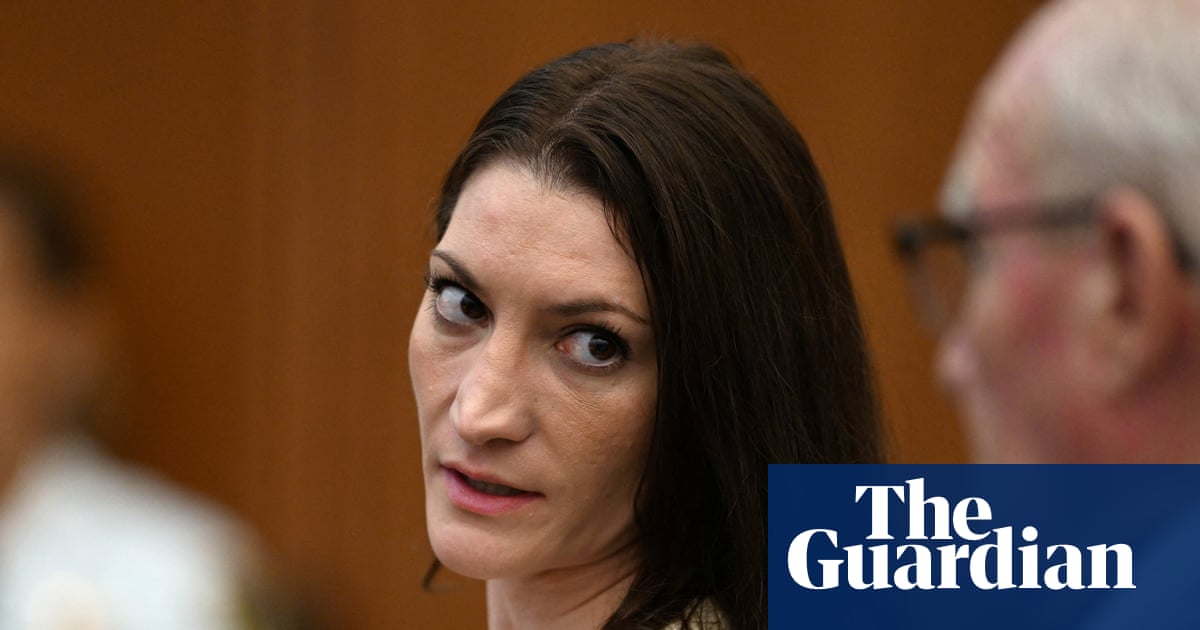
As the trial of Lindsay Clancy, the Massachusetts mother accused of killing her three children, starts to wind down, a now international discussion on social media about the case has hit a fever pitch as viewers examine details of the trial and question the state of maternal mental healthcare in the United States.
Amateur sleuths and armchair psychologists have been creating content throughout the several weeks of the trial, pointing out perceived discrepancies in evidence. They've pointed to Clancy's last recorded heart rate and body temperature as "smoking guns", suggested that Patrick Clancy, Lindsay's ex-husband and father of the children, actually committed the crime, despite no legal evidence to back up the claim.
"Obsessive engagement with trials is as old as the media," said Whitney Phillips, associate professor of information politics and media ethics at University of Oregon.
Phillips noted the infamous 1893 trial of Lizzie Borden, in which Borden was tried and acquitted of the axe murders of her father and step-mother. The advent of mass media, facilitated by the rise of technologies such as the telegraph and trains, allowed people to increasingly become informed on what was going on outside of their small town or village. In recent years, high-profile cases such as the Johnny Depp v Amber Heard defamation trial, the murder of Gabby Petito, and the trial of Karen Read have all sparked frenzied conversation and conspiracy theories online.
Platforms like TikTok optimize for engagement as opposed to following, making it easier for content to reach a large audience quickly, which is what experts say we're seeing in the Clancy case.
"People who otherwise wouldn't have been naturally interested in the story find that the story is pushed at them," she said.
Kathryn Coduto, assistant professor of media science at Boston University, agreed that social media algorithms are responsible for the heavy circulation of content surrounding the trial, including misinformation.
"Something like a conspiracy video is going to get a lot more legs than it would have in a different media environment," she said. "In a case like this, where there's been some interest relatively organically, now those algorithms are learning. Like, 'Okay, if we keep showing this, people are going to stay engaged.'"
Coduto also said that for many social media users, the Clancy trial allows them to participate in a dialogue as the case unfolds, fostering a sense of purpose and community.
"[This case] is happening at the moment, and I think that gives people something to really sink their teeth into," she added.
Taylor Vaughn Lasley, a screenwriter and professor at Syracuse University, is one TikTok user who has sunk her teeth into the case. On 4 August, she posted a video pointing out three components of the case that she would highlight as narrative devices in a hypothetical show.
"If I were making a TV show, and this is the story that we were telling in the show, these are the three things that I would purposefully plant for the audience so that they know perhaps that this woman did not actually kill her kids," she says in the video.
Vaughn Lasley noted that Patrick Clancy did not immediately check on his kids after finding Lindsay incapacitated, how low Lindsay Clancy's body temperature was when she was found, and that Patrick was now married to a doctor in New York City. The video quickly went viral.
Vaughn Lasley said that she built her following on TikTok making content analyzing current events and pop culture through the lens of a TV writer. While most of the response to her videos on the Clancy trial has been positive, she has also been accused of further sensationalizing the case.
"People say, 'You know, this is a real tragedy. These are real people's lives.' And I completely agree. Yes, these are real people. This is a real tragedy, and I have real expertise as a professional storyteller to analyze the stories that are being told," she said.
"And if, as a storyteller, I identify a hole or multiple holes in a story where I start asking questions, that doesn't mean that I'm trying to capitalize on or profit off of this tragedy. That means that I am asking questions about the story because that's what I do for a living."
While her account is monetized, Vaughn Lasley said she is not trying to pursue a career as a content creator. She did, however, note that she has made 30% more income on TikTok this month than months prior, coinciding with when she began posting about the trial.
The power of social media, especially TikTok, has not gone unnoticed inside the courtroom. Kevin Reddington, Clancy's defense attorney, even sought to add Emily Thorndike, who posted a TikTok video about her experience as an employee at McLean Hospital, the mental health facility where Clancy was admitted less than a month before the killings, to the witness list.
In the nearly 10-minute video, Thorndike pushed back on multiple claims from the prosecution, including one that Clancy was seen by a doctor every day during her stay at McLean. Thorndike said that since part of Clancy's stay fell over a weekend and a holiday, she did not have access to the doctor assigned to her case, and instead was seen briefly by a single doctor who was responsible for all 23 patients on the unit.
On 19 August, Thorndike appeared in a voir dire hearing at Plymouth county superior court, where Judge William Sullivan found her testimony credible but said he would not allow the testimony because of its "limited materiality" to the case.
"I was surprised that Reddington actually even bothered with her," Margaret McLean, a former prosecutor and trial lawyer, said. "It was almost like she was acting. Like this was her moment to shine."
Thorndike declined to comment to the Guardian.
While McLean was not impressed with Thorndike's testimony, she said there is value that platforms like TikTok hold for legal teams in today's media ecosystem.
"If I were Reddington, I would try to focus on what people are grappling with online [about the trial]," she said. "I would find a channel where the legal discussion was good and maybe see what some of the people are saying, because they reflect what a jury might be thinking."