The latest ONS Labour Market data has been released today. This is the latest estimate of employment, unemployment, economic inactivity and other employment related statistics for the UK from the Office for National Statistics, looking at the last three months of Labour Market data (July to September 2026).
The UK unemployment rate has fallen to 4.6%, the employment rate has risen to 75.4% and economic inactivity has fallen to 20.8%. The ONS said these quarterly movements partly reflect the rotation of the Labour Force Survey sample, with the group leaving the survey having lower employment and higher unemployment than the group joining it. Over the same period, the number of workers on payroll fell and vacancies dropped to 690,000, with the largest fall among the smallest businesses. Regular pay growth has slowed to 3.5%.
Vacancies down by 22,000 to 690,000
Early estimates for August to October 2026 suggest a decrease of 22,000 (3.0%) to 690,000, compared with May to July 2026. This is the largest quarterly fall since May to July 2025. Vacancies have fallen by 37,000 (5.0%) on the year. Outside the coronavirus pandemic, the last time there were 690,000 or fewer vacancies was in July to September 2014, when there were 686,000.
Vacancies fell in 11 of the 18 industry sectors. The largest decreases were in administrative and support service activities, construction, and transport and storage, each down by 5,000. The biggest fall by business size was among firms with 1 to 9 employees, down 22,000 to 73,000. Outside the pandemic, this is the lowest level for this size band since April to June 2012. The ONS said feedback from its Vacancy Survey suggests smaller firms may not be recruiting because of labour costs and other economic conditions.
Payrolled employees fall by 67,000 on the year
Estimates for payrolled employees in the UK fell by 67,000 (0.2%) between September 2025 and September 2026, but increased by 20,000 (0.1%) between August and September 2026. This is based on administrative data from HM Revenue and Customs (HMRC). When looking at July to September 2026, the period comparable with the ONS Labour Force Survey (LFS) estimates, the number of payrolled employees fell by 90,000 (0.3%) over the year and by 32,000 (0.1%) over the quarter.
Now 30.2 million payrolled employees
The early estimate of payrolled employees for October 2026 decreased by 95,000 (0.3%) on the year and by 34,000 (0.1%) on the month, to 30.2 million. The ONS said October figures are provisional and likely to be revised.
UK Unemployment rate is 4.6%
The UK employment rate based on the LFS for people aged 16 to 64 years was estimated at 75.4% in July to September 2026. This is up by 0.4 percentage points on the year and 0.3 percentage points on the latest quarter.
The UK unemployment rate for people aged 16 years and over was estimated at 4.6% in July to September 2026. This is down by 0.3 percentage points on both the year and the latest quarter, with 1.684 million people unemployed. The UK economic inactivity rate for people aged 16 to 64 years was estimated at 20.8%, down by 0.1 percentage points on both the year and the quarter.
UK Claimant Count is estimated at 1.714 Million
The UK Claimant Count for October 2026 increased on the month and on the year to an estimated 1.714 million.
Wages: Regular pay growth slows to 3.5%
Annual growth in employees’ average earnings in Great Britain was 3.5% for regular earnings (excluding bonuses) and 3.6% for total earnings (including bonuses) in July to September 2026, down from 3.7% and 3.8% in the previous period. Total pay growth was last lower in August to October 2020, at 2.8%. Annual average regular earnings growth was 5.4% for the public sector and 3.1% for the private sector. The ONS said the effect of the timing of public sector pay awards is now reducing.
Annual growth in real terms, adjusted for inflation using the Consumer Prices Index excluding owner occupiers’ housing costs (CPI), was 0.4% for regular pay and 0.6% for total pay in July to September 2026.
Liz McKeown, ONS Director of Economic Statistics, said:
“The latest figures provide a mixed picture overall. The employment rate increased and the unemployment rate fell in the latest quarter, though these movements partly reflect particularly large differences in employment status between the groups entering and leaving the survey.
“Over the same period, the number of workers on payroll fell. Vacancies also fell further, with the decline again concentrated in smaller businesses, which report that increased labour and operating costs are affecting their hiring decisions.
“Meanwhile, regular wage growth slowed, driven by a fall in public sector wage growth, as the recent impact from the timing of pay awards has started to drop out of the numbers.”
Dr Helen Gray, chief economist at Learning and Work Institute (L&W), said:
“With recommendations from the Milburn Review due to be published imminently, today’s labour market figures provide a timely reminder of the scale of the problem to be addressed. Around a million young people are not in education, employment or training (NEET) – a level not exceeded since 2013. Moreover, help is currently targeted at those on unemployment-related benefits, leaving three in four NEET young people with little support to progress into education or work. They are also hampered by the ongoing decline in employment opportunities in hospitality and retail, where young people often gain their first experiences of work. The number of jobs in these sectors has declined by 140,000 over the past year. The Milburn Review needs to produce action to tackle the factors that constrain employment opportunities for young people, as well as ensure every young person has access to the support they need to enhance their future prospects.”
Jack Kennedy, Senior Economist at Indeed, said:
“The labour market continues to weather economic uncertainty and higher costs, supported by the economy’s robust recent growth. But that resilience isn’t yet being matched by a recovery in hiring demand, with employers continuing to operate under a cloud of caution.
“Wage growth eased a touch but remains too hot for the MPC’s liking, supporting the case for a rapid fire second rate hike in successive months.
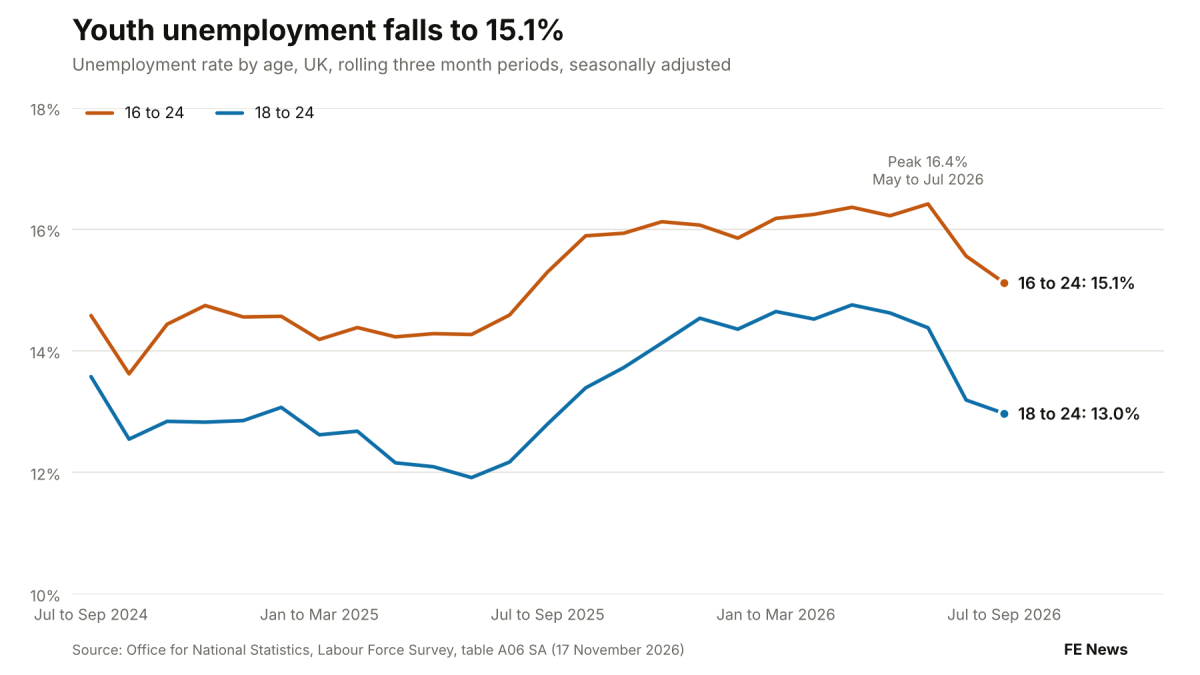
“Youth unemployment fell again but remains elevated by the standards of recent years at 15.1%, setting the backdrop for today’s Milburn Report to lay out the path to reforming employment support for young people and incentivising employers to hire young workers.”
Maxine Bligh, the Recruitment and Employment Confederation (REC) Interim Chief Executive, said:
“There is a mixed picture from the ONS today. There are encouraging signs with the employment rate up and the unemployment rate down in the last quarter. But progress is uneven and slower than
firms and jobseekers would like, with a sharp fall in vacancies, particularly from small businesses, in the official data continuing to flash a warning light on the dashboard.
“The decline in economic inactivity among 16 to 64-year-olds is helping to ease some of the concern that dominated labour market discussions just a couple of years ago.
“The challenge is turning progress into stronger hiring demand. Government policies will have to find greater traction with businesses and support confidence to create momentum in the job market
and a meaningful pickup in vacancies. This must include policymakers maintaining temporary work as a bridge to permanent employment. Government must act on the Milburn Review today to get the jobs market motoring again.”
Chris Goulden, Deputy CEO, Youth Futures Foundation, said:
“The latest labour market data from the Office for National Statistics shows that around 1 in 8 economically active young people not in full-time education (13.0%, around 429,000) are unemployed. A further 1 in 5 young people not in full-time education (20.8%, around 867,000) are economically inactive. While the number of young people not in full-time education who are unemployed remains stuck at similar levels, 55,000 more young people are economically inactive compared with a year ago.
“As we await the final recommendations of Alan Milburn’s ‘Young People and Work’ report in a few hours’ time, these figures are another stark reminder of the scale and persistence of the challenge facing young people who are not in education, employment or training (NEET). They underline the need for decisive, system-wide reform to improve opportunities and life chances for the hundreds of thousands of young people currently being left behind.
“Today presents an opportunity to begin driving this long anticipated and meaningful change. We have a moral obligation to improve outcomes for young people, but there is also a significant economic prize if we get this right. If the UK matched the Netherlands’ rate of youth participation – the best in the OECD – more than half a million additional young people could be in work or education, delivering a substantial long-term boost to the economy.”
Jeanette Wheeler, Chief People Officer at HR, payroll and finance provider, MHR:
“On the face of it, today’s ONS figures are good news. Employment has risen to 75.4% and unemployment has fallen to 4.6%. But the ONS has said this is partly down to changes in who is taking part in the survey, so the headline numbers should be treated with caution.
“Vacancies give us a clearer picture. They’ve fallen by 22,000 to 690,000, the lowest level since 2014 outside the pandemic. The biggest drop is in businesses with fewer than ten employees, where vacancies are at their lowest level since 2012, and the ONS says labour costs may be putting smaller firms off hiring.
“It’s timely these figures land on the same day as Alan Milburn’s review into young people not in education, employment or training. We’re expecting it to call for a guaranteed opportunity for every young person, more apprenticeships, and lower National Insurance for businesses hiring young people. It’s an ambitious plan and a welcome one, but it relies heavily on employers. A guaranteed opportunity only works if businesses are able to offer one, and right now smaller firms are pulling back.
“Bringing down the cost of hiring young people should be top of the government’s list. In the meantime, business leaders can start preparing by building links with local schools and colleges, rethinking what entry-level roles look like as AI changes the way we work, and investing in the skills of the people they already have.”