From gas-free training centres and renewable energy classrooms to community cycling projects and inclusive green skills programmes, further education colleges are demonstrating how sustainability can deliver lasting benefits for learners, employers and local communities.
Further education providers recognised at this year’s UK and Ireland Green Gown Awards are showing how sustainability can develop green skills, tackle inequality and support local communities alongside reducing carbon emissions.
FE colleges featured prominently among this year’s award recipients, with 27 colleges reaching the finalist stage across categories covering climate action, green skills, inclusion, student engagement and institutional leadership.
The awards, organised by EAUC in association with UKRI, recognise outstanding sustainability initiatives across post-16 education. Winners are selected by independent judging panels comprising sector representatives.
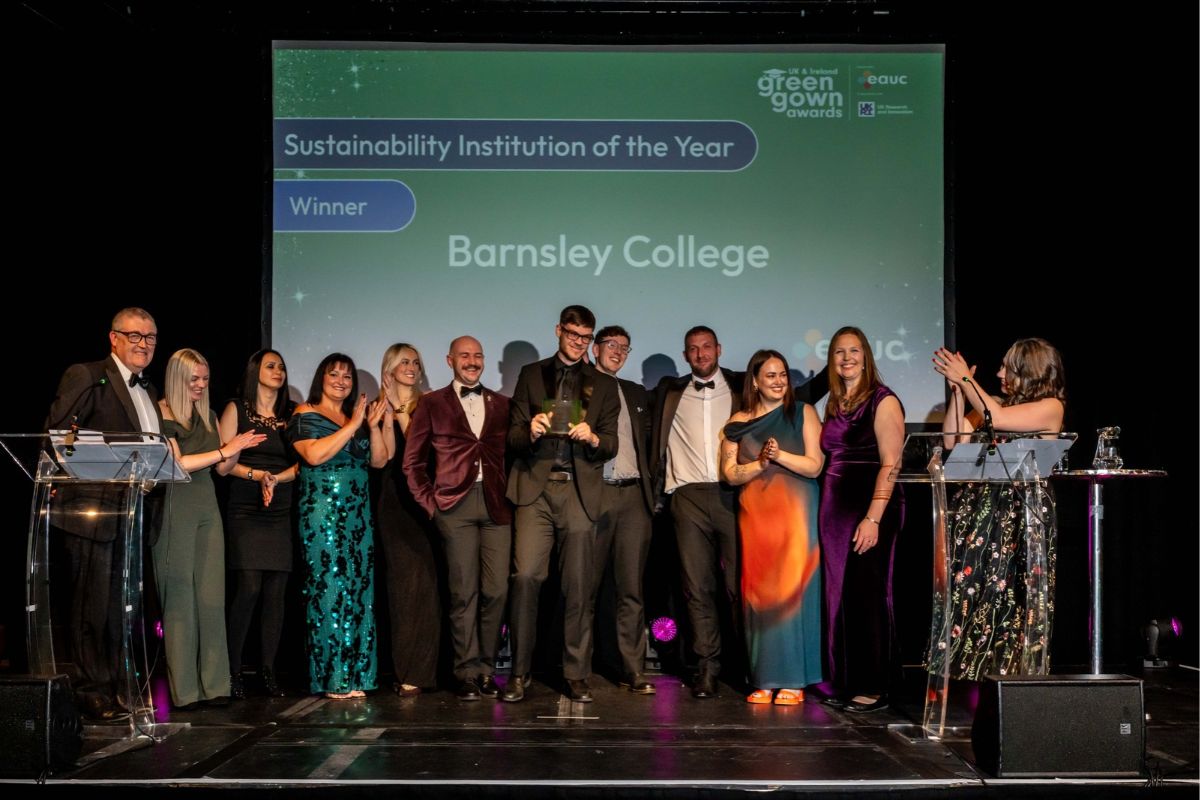
Barnsley College was named Sustainability Institution of the Year, with judges recognising its whole-organisation approach to embedding sustainability across its estate, skills provision, governance and curriculum. The college has transformed heritage buildings into highly efficient learning spaces, opened a gas-free Clean Energy Training Centre and embedded sustainability across its teaching through its SDG Ready programme.
Decarbonising estates while developing the green workforce
Bishop Burton College won Climate Action 2030 for its £3 million decarbonisation programme. The college has replaced gas boilers with heat pumps, installed more than 1,500 LED lights and 600 double-glazed windows, and reduced Scope 1 and 2 emissions by 26%. Importantly, the improvements have also created opportunities for students to learn alongside the changes, with the campus operating as a living laboratory.
Borders College was highly commended in the same category for an institutional strategy that places skills and teaching at the centre of its sustainability approach, rather than relying primarily on expensive capital projects. The college has achieved substantial emissions reductions since 2014/15 and has set a target of a 60% reduction by 2030.
Glasgow Clyde College won Next Generation Learning and Skills for what the college believes to be Scotland’s first fully off-grid classroom. Powered by renewable energy, the facility has been used to train hundreds of students and apprentices in solar photovoltaic technology and battery storage.
Making green skills more inclusive
Pembrokeshire College won Diversity, Equity and Inclusion in Sustainability for its SPARC Alliance programme, which addresses gender imbalance in energy and construction careers.
Nearly 400 learners have participated through accredited learning, mentoring, industry visits and employer partnerships. Participating schools have reported increased uptake of engineering, construction and design technology subjects.
Using college resources to benefit communities
Fircroft College of Adult Education, the country’s only independent residential adult education college, was highly commended in Campus Health, Food and Drink for its use of home-grown produce. Restoring its apple store enabled the college to use more than four times as much orchard fruit last year, while its new Plantry shop sells garden produce and honey from its own hives.
Newham College London won Creating Impact for a cross-college waste initiative developed using existing budgets and supplier partnerships. The college reports that nothing now goes to landfill, while recycling increased from 58% to almost 62% in a year.
Gateshead College was highly commended in Benefiting Society for The Bike Shed, an active travel hub developed with the local council. Since 2024, the project has recorded more than 4,000km of guided rides involving students, staff and local residents. Learners also refurbish donated bicycles for students, schools and community groups. ESOL cycling activities and wellbeing referrals help bring in people who might otherwise face barriers to accessing cycling.
Embedding sustainability into college culture
Glasgow Kelvin College was highly commended in Student Engagement for its student sustainability society, which leads campaigns, biodiversity projects and community activities across the college.
Lucy Reese of Morley College London was named Staff Sustainability Champion for her work tackling throwaway fashion through clothing fairs, classroom activities and partnerships supporting reuse and upcycling.
Sustained commitment, not one-off projects
Several of this year’s FE award recipients, including Barnsley, Bishop Burton, Glasgow Kelvin and Newham, were also recognised at last year’s awards.
Their continued recognition points to sustainability becoming an institutional priority, connecting workforce development, community benefit and leadership. Sharing the lessons behind these achievements can help colleges turn ambition into action within their own resources.
The full list of Green Gown Awards winners is available on the EAUC website.
The Green Gown Awards are open to all organisations across further education and skills, including adult and community learning providers, independent training providers and specialist institutions. Entries to the 2027 awards are expected to open in March.
Credit: EAUC/JMA Photography.