The proportion of GCSE students in England, Wales and Northern Ireland achieving at least a grade 4 (equivalent to a C) has fallen slightly this year, to 67.3% from 67.4% in 2025. This is the same as the proportion recorded in 2019, before the pandemic.
While it is a minor decrease, it still means nearly a third of teenagers are not achieving basic English and maths skills when finishing school. In England, students who fail to reach a grade 4 or equivalent in English or maths GCSEs have to retake them.
More students aged 17 and above took English and maths this year, likely due to the resits policy in England. But results show the pass rate has worsened for this cohort, falling by 1.4 percentage points for English and 1.7 for maths compared with last year.
That's all from us on the GCSE results live blog today, thanks for following along.
Here are the main developments from today:
-
The proportion of GCSE students in England, Wales and Northern Ireland achieving at least a grade 4 (equivalent to a C) has fallen slightly this year, to 67.3% from 67.4% in 2025. This is the same as the proportion recorded in 2019, before the pandemic.
-
The overall results for 16-year-olds in England nudged slightly higher compared with last year, with the proportion receiving grades 7, 8 and 9 – equivalent to grades A and A* – rising by 0.1 of a percentage point to 23.1%.
-
The proportion of nearly 700,000 16-year-olds in England who got a grade 4 (equivalent to a C) or better also rose to 70.7%, compared with 70.5% in 2025.

-
In England, London remains on top for pupils achieving a grade 7 or above, at 28.6%. This is a slight increase from last year, when 28.4% of GCSE students in the capital achieved the top grades. North-east England had the lowest figure, with 17.7% of GCSE entries awarded at least a 7, down from 17.8% in 2025.
-
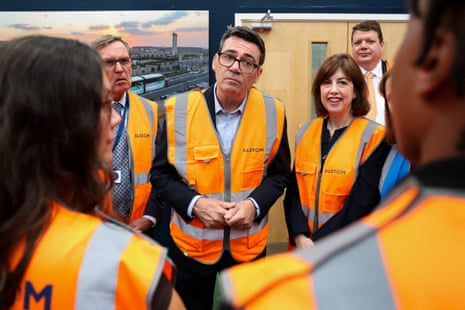
In a message to students, prime minister Andy Burnham said the government is creating "more opportunities" for young people to "choose the path that's right for them". He added: "Whatever your results, remember there isn't just one route to success."
-
Education secretary Lucy Powell said the government is looking at changing the resits policy in England, noting that only one in five students who resit English and maths were passing them. "For some, they're doing it many times over," she added. "So we're branding them a failure after failure after failure. It's knocking their confidence.
You can read our full report here:
Among those celebrating their GCSE results today were quadruplets Ellen, Eric, Layla, and Rose Lamb, who all attended Aureus School in Didcot, Oxfordshire.
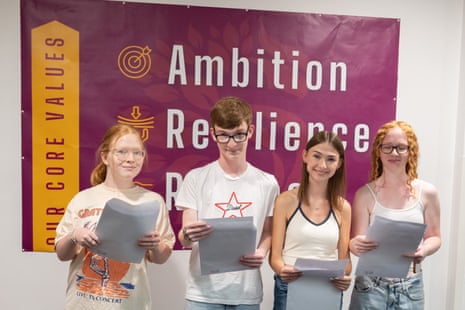
Ellen achieved one grade 9, five grade 8s, three grade 7s, and one grade 6. She is heading to Oxford City College to study A-levels in biology, chemistry and maths and hopes to become a paediatrician.
"I've really enjoyed the sense of community at Aureus," she said. "The teachers have always been incredibly supportive, and encouraged me to challenge myself both academically and personally.
"Some of my favourite memories include our Year 11 prom, taking part in the school production, and celebrating after completing our GCSE exams."
Eric is going on to study dance, while Layla will be studying English, history and psychology at sixth form and Rose will study history, sociology, and English A-levels.
Gender and golf course studies are examples of "Mickey Mouse" degrees, Suella Braverman has said.
Asked to name a specific degree which falls under Reform UK's definition of a "Mickey Mouse" course that should be avoided, the party's education spokesperson said:
In terms of Mickey Mouse courses, listen, this has been well-chronicled for many years. Whether it's gender studies, whether it's golf course studies, I think I've seen there's not a necessity. There's not a value in many of these degrees.
Now I know that might be uncomfortable to those people who have those qualifications, but the reality is you've got to ask yourself: what are your graduate outcomes looking like?
Have you really spent three years of your life in the best possible way, and was it worth £50,000 worth of debt.
Young people are coming out of university unable to get on to the housing ladder, unable and unwilling to get married, unable to start a family. Why? Because they're starting off with their hands behind their backs because they've been sold a line that university is the pathway to success.
Suella Braverman has urged young people getting their GCSE results not to "waste your time studying for a pointless degree at a mediocre university".
The Reform UK education spokesperson made the comment as she set out the party's plans to create 600,000 more apprenticeship starts a year by the end of the first term of a Reform government.
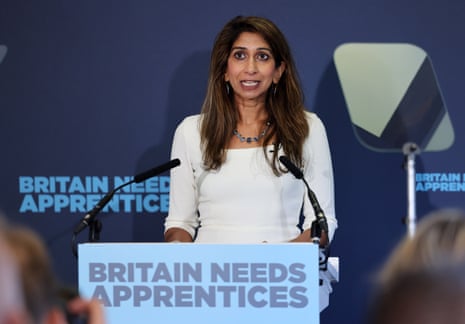
As she set out the policy, Braverman addressed students receiving their exam results, telling them:
My advice to those young people today getting their results, my advice to those grandparents and those parents looking at the young people in their families who may be getting their results today: Be careful, don't get ripped off by the great university scam.
Don't waste your time studying for a pointless degree at a mediocre university. If you want to work hard, if you want to move forward, earn a wage, and have opportunities in your life, take up and look for apprentices.
And a Reform UK government will ensure that those opportunities exist. Your success is our country's success. We're on your side, and when I said I wanted a skills revolution, I meant it."
For more UK politics news, follow our live blog here:
director of which represents 1,150 schools in the regions, said there was some "genuinely encouraging news" in today's results.
At grade 4 and above, the gap between the north-east and London has narrowed and is back to around where it was before the pandemic.
But the picture at the highest grades remains concerning. The gap at grades 7 to 9 has increased again this year and remains wider than it was in 2019.
The movement each year might look relatively small, but the important point is its persistence. Year after year, this divide remains; and is then reflected in student destinations, employment rates, and HE progression rates.
We have to understand what these figures are telling us. There is not a north-south divide in the quality of schools, nor in the talent, potential or aspirations of young people.
There is a structural divide in the circumstances and opportunities surrounding them.
Schools in the north-east are working incredibly hard to overcome those circumstances.
But schools cannot independently fix poverty, stretched public services, shortages in special educational needs and disabilities (Send) support, transport barriers, unequal access to enrichment or very different local economic opportunities.
These inequalities are neither inevitable nor acceptable. The government needs to treat them as a system challenge and address the conditions around schools as well as what happens inside them."
PA has reported a heartwarming story about a Sudanese refugee who passed his GCSEs in English and maths.
Nasser Hamid, 20, of Ipswich, achieved grade 4 in both subjects, collecting his maths results today after having passed English earlier this year.
He studies at Suffolk New College, where he is also taking an IT course.
On finding out he now has his English and maths qualifications, he said: "I feel proud – it is one of the proudest moments in my life – this is the result I was waiting for to step forward.
"Thanks to Suffolk New College, without their help I wouldn't be standing here."
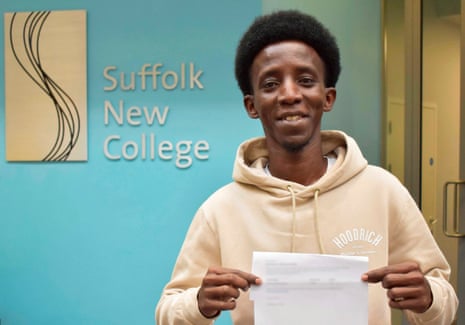
Nasser is an aspiring football referee, after an injury ended his dream of being a professional player. He recently oversaw a charity football match at Ipswich Town's ground, Portman Road, and said he would love to referee at a future World Cup.
He also officiates at Saturday and Sunday league games.
He urged others in a similar position to "just believe in yourself".
"With discipline and hard work, you can achieve your goals," he said.
Nasser said he was "pushing forward to be an engineer".
"I'm on track," he said.
"Next, I'm going to do an access course and then (hopefully) go to university to study engineering."
David Squire, head of maths at Suffolk New College, said: "I've never been prouder of a learner in my life."
On subject choice, statistics and business studies may have grown in popularity this year – up 11% and 8% respectively – but computing has dipped 7%. Myles McGinley, managing director of Cambridge OCR, explained: "The emergence of AI could be leading to students thinking they don't need to know how to code.
"But I would say maybe that's something that would be up for debate. I think potentially computer science is more important than ever in the age of AI.
"And while vibe coding might be all the rage, I think AI won't be able to replace a solid understanding of how software works, how technology can solve real-world problems and how it can create a good user experience."
One of the key areas of concern following today's GCSE results will be the high failure rates for those students in England forced to resit English and maths GCSE after previously failing to secure a pass at the age of 16.
It is a longstanding problem and the government has already proposed the introduction of a "stepping stone" qualification to help better prepare students who are struggling but frustrated school leaders said more fundamental change is needed.
Paul Whiteman, general secretary of the NAHT school leaders' union, said: "We have long called for an end to the current policy which forces students into dispiriting rounds of repeated, demotivating resits.
"The curriculum review focus was on ensuring students are better prepared for resits and introducing a stepping stone qualification.
"Today's data shows why more fundamental changes to this policy are needed, with only 18.8% of students aged 17 and over achieving a grade 4 in English, and 13.6% of students achieving a grade 4 in maths – both down on last year, when these figures were 19.7% and 15.3% respectively.

"What is needed are more appropriate and engaging alternatives to GCSEs in English and maths at key stage 4 which enable students to study for qualifications that better suit their needs and aspirations."
Girls continue to outperform boys at GCSE, but the gap is closing and is now 2.9 percentage points (pp) lower than it was in 2019. Richard Harry, executive director of qualifications and assessment at the Welsh exam board WJEC, urged caution however.
"The gap is only very slightly narrower this year – it's a very small change," he said. "I think it would be difficult to speculate too much around the differences for such small changes."
Concern will also focus on persistent regional differences, with London once again the highest performing area with 28.6% of grades 7 and above, up 0.2pp from last year. In the north-east, the lowest performing region, 17.7% of grades awarded were 7 and above, down 0.1pp from last year.
Carl Cullinane, director of research and policy at the Sutton Trust education charity, said there had been "no progress" in addressing regional imbalances in GCSE performance, with the gap between London and the rest of the country continuing to grow.
"Forthcoming curriculum and assessment reforms, and future government spending decisions, must have a laser focus on closing gaps in attainment and progression across the country."
The Sutton Trust also pointed out that the gap between state comprehensives and private school pupils getting the top grades may have narrowed slightly by 0.9pp, but it remains vast at 27pp.
Looking at the results in England on a regional level, remains on top for pupils achieving a grade 7 or above, at 28.6%.
This is a slight increase from last year, when 28.4% of GCSE students in the capital achieved the top grades.
had the lowest figure, with 17.7% of GCSE entries awarded at least a 7, down from 17.8% in 2025.
This means the regional gap has widened between the highest and lowest proportions of pupils achieving a grade 7 or above, from 10.6 percentage points last year to 10.9 points this year. It is the largest gap since the start of available data in 2010, according to analysis by PA.
Here's what the data says about the other regions:
-
18.9% of entries received a grade 7 or above, up slightly from 18.8% in 2025.
-
The gap widened to 9.7 percentage points, from 9.6 in 2025, close to the recent record of 9.9 points in 2024.
-
18.2% of entries received a grade 7 or above, 10.4 percentage points behind London, up from 10.3 in 2025.
-
18.3% of entries received a grade 7 or above, 10.3 percentage points behind London, up from 9.9 in 2025.
-
Wider regional divide: The gap between London and both the East and West Midlands has widened to its largest level since at least 2010.
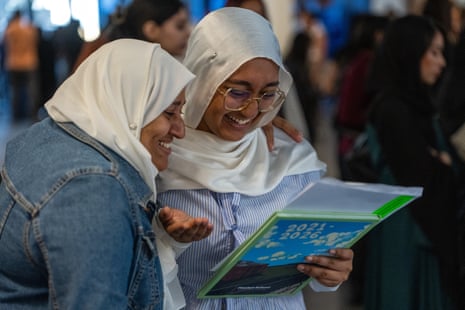
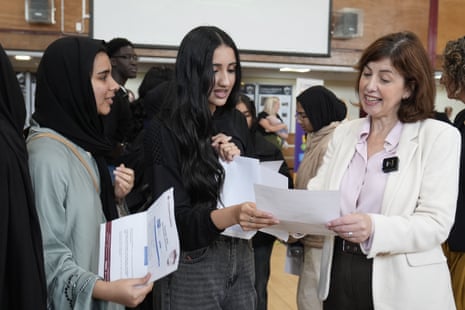
Here some pictures on the newswires of students picking up their GCSE results today:




Almost a fifth (19.6%) of boys' GCSE entries were awarded a grade 7 or higher (equivalent to an A) compared with nearly a quarter (24.4%) of girls' entries, a 4.8 percentage point gap, down from 5.1 last year.
Overall, 70.2% of girls achieved a pass rate (grade 4 and higher) compared with 64.4% of boys, a 5.8 percentage point gap, a decrease from 6.2 last year.
These are the narrowest leads enjoyed by girls since at least 2000, which is the earliest archive data available, PA reported.
The proportion of GCSE students in England, Wales and Northern Ireland achieving at least a grade 4 (equivalent to a C) has fallen slightly this year, to 67.3% from 67.4% in 2025. This is the same as the proportion recorded in 2019, before the pandemic.
While it is a minor decrease, it still means nearly a third of teenagers are not achieving basic English and maths skills when finishing school. In England, students who fail to reach a grade 4 or equivalent in English or maths GCSEs have to retake them.
More students aged 17 and above took English and maths this year, likely due to the resits policy in England. But results show the pass rate has worsened for this cohort, falling by 1.4 percentage points for English and 1.7 for maths compared with last year.
The the national organisation for humanities and social sciences, said its analysis of GCSE results today shows business and psychology are up but languages face another year of decline.
Among its key findings were:
-
seeing its sharpest fall since 2018, with a 5.4% decrease in take-up this year.
-
Other modern languages, which includes Arabic, Chinese and Urdu among others, are also down by 4%.
-
growth may be slowing down, with a 0.3% increase compared to 2.6% last year and 6.2% the year before.
-
is up 0.2%, a very small increase compared to its long-term decline of 12.5% over the past 5 years.
-
The highest growing subjects in (the acronym for social sciences, humanities and arts) was with a 7.9% increase.
-
and continue to rise, by 4.8% and 3% respectively.
president of the British Academy, said: "This year's GCSE entries show that young people continue to be inspired by subjects providing insight into people, economy and society.
The growth of business studies, sociology and psychology, in particular, show increasing appetite for skills nurtured by the social sciences, arts and humanities."
However, the continued fall in language entries is concerning. Languages are vital for diplomacy, trade and cultural understanding. AI translation is no match for the human communications skills and capabilities we need to navigate an increasingly interconnected, but divided and volatile world. Yet, losing languages at this level has a domino effect across the entire education system, and once this expertise disappears, it will be very hard to recover.
As government reflects on future education pathways, we urge ministers to seize every opportunity to give all young people access to a broad, balanced curriculum, delivering the critical thinking and creativity that employers value and the UK needs."
Here are some statements from the prime minister and the education secretary on the GSCE results today.
Congratulations to everyone collecting their results today, you should be proud of the hard work that got you here.
Whether the next step is sixth form, a college course, an apprenticeship, a T Level, work, or something else entirely, we're ensuring that there are more opportunities than ever to choose your own path to get on in life. I'm determined to bring back hope and give every young person the chance to fulfil their potential.
Massive congratulations to everyone collecting their results today – be proud of what it took to get here, and thank you to the teachers and families who backed you every step of the way.
More of you are hitting top grades in maths, and technical pass rates are climbing in every region. That's proof there is no wrong door, only different routes that suit everyone's individual ambition.
But there's more to do to put academic and technical qualifications on an equal footing, so we're introducing V Levels and expanding T Levels and apprenticeships, so wherever you're headed next, there's a path that works for you."