State health officials were so alarmed by a controversial federal government aged-care funding tool that they kept a log of hundreds of cases where vulnerable older Australians were severely under-assessed.
It also led to one senior state health official writing to the federal government to warn of "catastrophic" outcomes from its algorithmic tool – used to determine support levels for in-home care – and that her staff were "fielding calls from distraught clients and assessors".
Documents obtained by Guardian Australia under freedom of information laws show officials from four states and the Northern Territory recorded systemic errors that had occurred since the federal government rolled out the Integrated Assessment Tool (IAT) last November.
The IAT includes a questionnaire completed by aged care assessors from state and territory health departments. The information is then analysed by an algorithm which determines the level of funding a person receives for support at home packages, as well as their urgency of need.
The documents reveal the algorithm was designed by federal health and ageing staff, led by four assistant secretaries overseeing five departmental data scientists, a principal cost modeller and a director.
Days before the IAT was rolled out, the department barred the IAT's decisions from being overridden by assessors.
Within days of launch, people were being under-assessed by the algorithm, the documents released by the federal department of health and ageing reveal.
Assessors reported feeling powerless and ethically challenged while clients were left at risk of deteriorating, remaining in hospital, or being forced into aged care, the documents show.
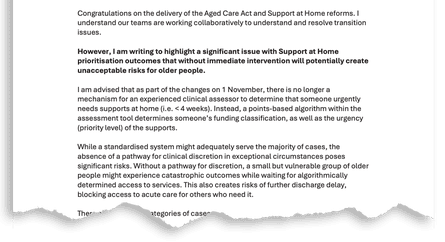
The director general of WA Health, Dr Shirley Bowen, became so concerned that she emailed her federal counterpart with a warning.
"Without a pathway for discretion, a small but vulnerable group of older people might experience catastrophic outcomes while waiting for algorithmically determined access to services," she wrote on 24 November.
"This also creates risks of further discharge delay, blocking access to acute care for others who need it."
The documents released to Guardian Australia show departments around the country also emailed their concerns within days and weeks of the tool's rollout.
'Numerous concerns'
In a 7 November email, a staff member with Aged Care Assessment Victoria wrote to the federal health department about feedback it was receiving about "concerning outcomes from the IAT algorithm and the assessors not being able to override the outcome".
"The assessors are feeling conflicted as they do not agree that the IAT algorithm outcome reflects the clients' needs," the email said, providing a list of examples.
On 13 November, less than two weeks after the algorithm was introduced, a representative from NT Health emailed the federal government about "concerns regarding the algorithm and erosion of clinical judgement within the new assessment system".
"Attached are some examples of clinical assessments conducted in the past week that have resulted in unexpected outcomes," wrote the NT Health planning system staffer.
"Assessors and delegates are feeling very disheartened that they are no longer able to use their clinical judgement and years of clinical experience to over-ride the IAT recommendations, to achieve optimal consumer outcomes.
"These outcomes have required many difficult conversations with consumers, families, and providers … this combined with the lack of respite in the NT is likely to lead to increased carer stress and increased hospital admissions."
The email said the algorithm was particularly failing those with "good" physical abilities but have "significant cognitive impairment".
A day later, WA Health's strategy and governance department also emailed spreadsheets of issues and complaints about the algorithm to the federal government. It sent a second email – marked with high importance – on 20 November that outlined "numerous concerns across most of our outlets regarding … inappropriate SAH (support at home) classifications".
"Approving classifications and assessment outcomes that they [aged care assessors] do not agree with does not align with their professional ethics and they are concerned this has possible legal impacts," the email said.
The WA Health official said there needed to be a way to quickly escalate errors or override decisions. "Keen for any quick advice you can provide on this to avoid negative impacts on older people," the email said. "Staff attrition is a very real issue for us at the moment."
In Queensland, a state health staffer sent a spreadsheet listing more than 100 examples of "unexpected IAT outcomes" to the federal government on 18 November.
In all but a few cases, the algorithm had under-assessed the person's needs, the member of Queensland Health's policy and planning division said in the email, and they will "continue to collect examples over the coming months".
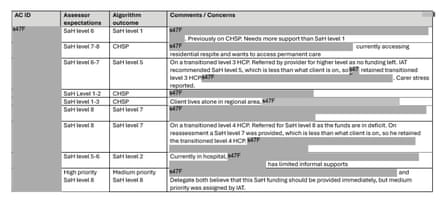
Within a week, a similar spreadsheet was sent by NT Health, while a representative from the Northern NSW health district separately raised a number of issues with the IAT and asked for legislation to be changed to allow for assessors to override wrong algorithm decisions.
'Our hospital teams are at a loss'
In her 24 November email, Bowen, who heads WA Health, said older people who needed commonwealth-funded home support in order to be discharged from hospital previously received an urgent funding package within four weeks.
Hospital staff would arrange discharge to short-term rehabilitation or other services in the interim, she said in the email.
"These same clients are now classified as 'medium' priority, with an estimated 8-9 month wait time until support at home services commence. Our hospital teams are at a loss as to how to manage discharge in such circumstances," she wrote in the email.
On 12 March, NSW Health sent a spreadsheet titled 'Misaligned IAT outcomes', recording more than 50 cases where state-employed clinicians found the algorithm's funding determination failed to match a person's needs.
Asked to comment on the logs of inadequate assessments and concerns revealed by the documents, a department of health spokesperson said: "We've listened to people's experience of the system, and we'll deliver a practical, responsible safety net that supports the older people whose circumstances don't fit neatly into a tool".
"… the government will legislate a new assessment escalation pathway to ensure decisions can be reviewed and changed when necessary," the spokesperson said.
The government has stopped short of returning human oversight and the ability for assessors to immediately correct wrong algorithm decisions, despite growing calls from clinicians, advocacy groups and politicians. Instead, the aged care minister, Sam Rae, said in July assessors would have the option to escalate cases to a system governor.
This differs from the existing, lengthy review process, as assessors will be able to escalate cases rather than relying on the older person to start the process. It remains unclear how long the new escalation and review process will take.
The documents released to Guardian Australia separately show a number of aged care advocacy organisations – including Ageing Australia, the Older Persons Advocacy Network (Opan), and Dementia Australia – also sent detailed examples of the algorithm's failures to the federal government soon after it was launched.
"Delays in assessment, algorithmic misclassification, and inaccessible review processes create a cycle in which urgent needs are not recognised, carers are pushed to exhaustion, older people deteriorate without support, preventable hospitalisations and premature residential aged care entry increase, [and] some individuals die before receiving any assistance," Opan wrote to senior department staff.
In December, a staff member of Dementia Australia wrote to the department to say the organisation was "very concerned" by feedback about the IAT. The organisation said support services were telling people with dementia not to bother asking for an IAT assessment "as they have seen a number of people with dementia receiving less or no support … even if their care needs are increasing".
In response, a staff member from the department wrote the algorithm had been designed to consistently determine an older person's home support classification.
"This approach ensures that people with similar characteristics and functional needs receive the same level of funding to support their aged care needs," the response said.
Guardian Australia previously revealed the experts consulted to develop the IAT questionnaire were not told the tool would be underpinned by an algorithm being developed internally by the government.
Do you know more? melissa.davey@theguardian.com